It's the most sacred vow of medicine:
"First, do no harm"
And for the most part, doctors do a good job of keeping it.
But recently, it's become harder and harder for health workers to uphold their Hippocratic oath.
And as thousands of doctors and nurses fall prey to the vicious Covid-19... while countless infected people are flocking into infested hospitals... lots of seniors are wondering: "am I pushing my luck?"
It's something that prompted even the CDC, at the height of the first wave, to advise older folks with chronic conditions to "stay at home as much as possible".
It seems as though millions of Americans with diabetes, heart disease or any other chronic health problems are now between a rock and a hard place. It's a deadly dilemma: If you're not feeling well, you need immediate medical help, or risk getting sicker. But if you do go to the hospital, you face the risk of getting Covid-19 from another patient who doesn't even know they have it... or worse, from the very doctor or nurse who is supposed to take care of you.
If this scenario frightens you sounds like you, don't worry - you're no coward. It just means you're smart enough to understand the risks. And these risks are real:
In fact, the CDC reported that
... over 62,000 health professionals got infected until May 26...
and numbers only went up from there. We know for a fact that hospitals are a major source of Covid-19 infection. In the UK, up to 20% of all infections happened in hospital, while people were getting treated for something else. And even though the US authorities haven't been too transparent with these numbers... we know that at least 9000 Americans came back home from hospitals with the bug. The real numbers are likely much higher.
But amid this unmitigated disaster, there's a ray of hope. And it's coming from the same place that made this country the best in the world: American self reliance. Because while the most dangerous pandemic in over a century is raging on, tens of thousands of patriots have started taking matters into their own hands. And they're staying healthy and safe even when there's no doctor... or at least until they can safely go to a hospital.
Hi, my name is George- and on this page that I might be forced to pull from the Internet soon, I am going to show you why, if you've been postponing going to the hospital for anything non-essential, you might be right... and why soon enough there might not be a doctor available, even if you need one.
I'll explain exactly what medicine this "battle-hardened" surgeon from Europe recommends you stockpile now... to prepare for the looming drug shortages...
I'll show you how to get a list of all the natural remedies you need to hoard for long-term survival. And what are the simple yet essential medical techniques and procedures you need to know in a medical emergency.. so that even if there's no doctor, or you can't visit one, you can still manage your chronic conditions, reduce your pain, and even restore your health until the doctor can see you.
This is especially important if you or a family member are at risk:
According to the CDC, 8 out of 10
COVID-19 deaths were from people over 65!
No wonder I'm taking this more seriously than anything.
Like I said, my name is George and I am from Survivopedia.com - one of the leading survival websites on the Internet. Odds are, you don't know about us. Many people don't. In good times, people hate us for "being wrong" and for somehow "spreading fear". In bad times like these, we are hated for being right. You just can't win with these guys.
I've heard it all - that I'm a conspiracy theorist, a tinfoil hat, crazy prepper - you name it.
But over time, I learned to stop paying attention to the trolls and internet idiots. And I realized that we were not alone. When we published Backyard Liberty and showed people how to prepare for a food crisis, more than 140.000 Americans heeded our calls. Even more were interested in our EMP preparedness course. We help patriots prepare for unlikely but devastating events - like the current pandemic.
And this time it's more personal than ever. Because you see... I'm one of those "seniors with underlying conditions" you keep hearing about. My health, maybe like yours, is far from perfect, but I manage. I used to do many stupid things when I was young. We all did. But it doesn't mean we deserve to die. No one does. And frankly, ...
I won't go gently into that good night!
Not if I can do something about it.
That's why, in the early days of the pandemic, I put my nose to the grindstone... and spent hundreds of hours researching this novel threat. And what I discovered shocked me to the core: hard evidence that we're about to witness a healthcare apocalypse of biblical proportions. And NOT directly from Covid-19... but from its consequences.
Big words, I know... and I double checked the evidence in hope I was mistaken. But I'll show you all my proof here and so you can either prove me wrong... or realize that the time to prepare is now, while there's still time.
The numbers don't lie: millions of Americans have already "opted out" of the healthcare system. Hospital visits were down nearly 55% in March and April, in an analysis by Strata Decision Technology.
People are getting it: in the middle of a pandemic,
the last place where you want to be is
a building where all the sick people go!
Because frankly, it doesn't take much to get infected in a hospital. Hospitals are notorious for making people sick - even without a pandemic. The CDC estimates roughly 1.7 million hospital associated infections... that cause or contribute to 99.000 deaths each year! And that's BEFORE the coronavirus.
Covid-19 makes this worse. People don't realize just how easy it is for a nosocomial outbreak to happen - that is, for your hospital to infect you. A recent Harvard Medical School study puts it this way:
"To cause a nosocomial outbreak, it will take just 1 patient with occult COVID-19 who is hospitalized, tests negative for influenza virus, and is taken off precautions despite persistent respiratory symptoms. Or just 1 visitor with COVID-19 and mild respiratory symptoms who is permitted free access to the hospital because it does not have an active screening and exclusion policy for visitors with respiratory tract symptoms. Or just 1 infected health care worker who decides to soldier through a shift despite a sore throat and runny nose"
But there's another side to this story that should give you the jitters.
Because...
... soon, you may discover that you
can't go to your hospital... because it
doesn't exist anymore!!
This might sound crazy but it's 100% true. As expensive as healthcare is in the US... people don't realize just how fragile hospitals are. And many of them are laying off personnel at an unprecedented scale... or they're even going bankrupt.
You see, during the pandemic, hospitals were forced to halt elective surgery - which accounts for a big chunk of their revenues. With elective surgery gone, their revenues dried up. How much? A whopping $200 Billion with a capital B, and these are June numbers.
It's enough to send many hospitals to the brink of financial ruin - and beyond.
We've already had 29 hospital bankruptcies in 2020. But that's just the tip of the iceberg - especially for rural hospitals. Michael Topchik, executive director of the Chartis Center for Rural Health, says that 453 of the country's 2000 rural hospitals... close to 1 in 4... are in danger of closing... while 216 are most vulnerable.
Not even the giants are faring better:
Mayo Clinic is expected to lose at least $3 billion in revenue this year...
...and has already undergone pay cuts and layoffs. If Mayo Clinic is in bad shape... you can imagine just how much worse the smaller hospitals are doing.
But wait, there's more:
Because simply avoiding doctors and hospitals is not going to cut it. In fact, it might make things worse!
In fact, if that's your plan, maybe you're better of playing the COVID-19 lottery, and just going to the hospital. Because "doing nothing" is not much of a strategy... and people have started paying with their lives.
It's true:
stats are showing a sharp increase in heart attacks and stroke...
with at least 35% of the excess deaths NOT caused by the coronavirus. Take D.C. for example: according to the DC Health director, excess deaths in the state were 40% higher from January to May than they were just one year before. And almost half of those were not attributed to the novel virus - instead, to conditions like pneumonia, flu, diabetes, cancer and overdoses.
And this begs the question:
How will Americans deal with chronic conditions when it's not safe to visit a doctor?
How will the millions that suffer from heart conditions... diabetes... kidney disease... or COPD... where will they go when their hospital is closed? What will they do if - or when there isn't enough medical personnel to take care of them?
It's the deadly dilemma: Go to the hospital and risk getting sick, or stay home and risk getting sicker.
There is a third way - the very thing that helped make America the greatest country in the world. Self sufficiency. And I'll show you how becoming medically self sufficient will help you slash your risks of getting sick... and keep your health in the best shape you could hope for... even if the pandemic decides to stay with us for a long time.
So what can you start doing right away to become medically self reliant?
There are two simple steps:
Step 1 is to start stockpiling essential medicine, that might be gone in a crisis. Studies have shown that there are 153 critical drugs that people with chronic disease need right now - or else they with die. Many of them are made in China or in India. We were already experiencing shortages even without a pandemic. With so many factories closed, and governments limiting exports, you need to brace yourself for possible worldwide disruptions.
So what medicine to stockpile? I have a special list from a top survival doctor, and I'll share it with you here on this page in a moment.
But that's just the beginning. Step #2, and probably THE most important thing, is...
... you have to internalize some basic medical skills that could save your life in a "no doctor" scenario
Look: knowledge is power, and even the most basic medical knowledge will give you the power to save lives - yours, or a family member's.
In case you're thinking I'm nuts for even considering that you learn basic medical procedures... I know how it sounds. What am I saying here, that you'll perform your own surgery? That you'll treat some serious health problems, like a stroke or heart attack?
No. If any of that happens AND there is no doctor, I hope you scored good points with God - because you're going to need all of HIS good will. But...
...just because you won't
perform your own brain surgery, doesn't mean
there aren't things you can do
Quite a lot, actually!
You can learn to prepare for nervous, respiratory, circulatory, digestive and urinary system diseases.
You can manage superficial wounds and even fractures.
You can give first aid.
You can learn to self diagnose a medical problem (with some help). Perform CPR. Stop bleeding. Deal with trauma. Deal with hypothermia and hyperthermia. Fight infection. And so much more - all in a few hours of casual reading.
How do I know this? Years ago, when the Ebola pandemic happened, I was afraid that it was going to be "the one". Luckily, that wasn't the case. But while I was reading every available source, and doing my research, talking to doctors, etc... it occurred to me. Not all doctors are alike in a "no healthcare" situation.
As I was doing my Ebola research, it struck me that the best doctor for a medical crisis will probably not be some "silk underwear", Porsche-driving doctor from a billion dollar hospital. My best bet was someone from the trenches. A doctor who is forced to perform miracles with no expensive, state of the art technology. And while facing severe drug shortages. In short, ...
... I needed a 3rd World Doctor
If I wanted to learn from the best... I knew that the best crisis doctor would be someone who fights crisis on a day to day basis. And after a few months of research, I found my guy-in one of the poorest countries of the European Union-Romania.
His name is Dr. Radu Scurtu-and he's a rather unusual surgeon. While he's working within the state-of-the-art French healthcare system... he earned his stripes in the terrible healthcare system that Romania had in the early 2000's.
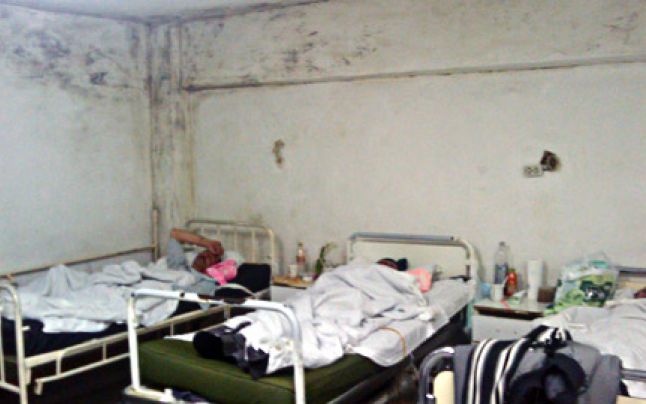
The doctor had seen it all. No electricity. No proper disinfectants. Having to seat 2 patients in the same hospital bed, because of shortages. Rats and cockroaches. Things that would make your stomach churn-and that you'd never see in the US under normal circumstances.
Dr. Scurtu managed to get out of that system-first, working for a few years in Germany, before moving to France. But he took with him a wealth of information on how to deal with a collapsed system. What's more, moving from "stone-age" to "state of the art" meant he could get the best of both worlds. Romania had taught him self reliance and ingenuity. Western Europe provided the expensive toys.
It reminded me of a lesson I learned from my grandpa-a self made multi-millionaire, but who had weathered two wars and the Great Depression. While Grandpa was happy to enjoy a life of luxury, he always liked to remind us that it can and it will all go away. He had lost it all multiple times-and had made it all back in multiples, with the help of God and of his own good attitude. Grandpa was fond of saying:
"There is no education like adversity"
When you think about it, it makes sense. Should the healthcare system collapse, most of our fancy pants doctors will be screwed. They have no idea what it's like to operate with a flashlight. Or what to do with a patient when basic medicine is out of stock, and the fancy equipment is hogged by thousands upon thousands of sick people.
They will be overwhelmed. And WE are going to be the ones who will suffer the most.
When I met Dr. Scurtu, one of my first questions was "what can I do to fend for myself in a medical crisis?". I was expecting the same run of the mill response I had gotten tens of times from other doctors-that you shouldn't try to play doctor, that I should go to the hospital, yada yada yada. I knew that, I'm not an idiot. But what if there IS no doctor, and no hospital?
Dr. Scurtu was more than happy to take my question. And he gave me an earful. Turns out, short of surgeries and complex medical procedures, there is quite a lot of stuff you can do! Here's some of it. But first, a disclaimer:
Don't try any of it without talking to your doctor first!
I'm giving this for information purposes only. If you have a doctor you can access, call him. If you can go to a clinic, do it. That's the safest course of action, and it would be irresponsible of me to suggest otherwise.
Below you'll discover what a doctor does when they can't go to a hospital. Use your own discretion.
Here's what I learned from Dr. Scurtu: that if you want a good chance of being to treat something properly, you first want to know you diagnosed it right. He taught me the simple TeCaMoLo principle. These are the core questions you need to ask, to clarify the circumstances in which the injury happened:
TeCaMoLo:
TEmporal-when did the injury occur?
CAuse-why did it happen?
MOdal-how did it occur?
LOcation-where did it happen?
Ask these 4 questions and you'll have a proper baseline for healing the patient.
Beyond that, the Dr. showed me ...
... how to recognize the signs of medical distress
Is the patient pale? Does he or she have a too weak or too rapid pulse? Are they confused? Are there any obvious signs of injury?
The doctor then showed me how to perform a body check (more about this later). And hundreds of little tidbits that could save your life. For instance, do you know why it's a good idea to have an old-school glass syringe in your house? It's because you can sterilize and safely reuse glass... unlike the disposable syringes. In fact, it's probably a good idea to buy some medical pliers and pincers, to have just in case.
I asked Dr. Scurtu what medicine to stockpile - in the event that you won't be able to find them in a crisis. This is particularly important now-with global supply chains falling like dominos. He gave me more than a handful.
Let's start with the obvious.
What should you have on hand, in case of pneumonia?
Try to have some Cipro around the house. For kids, Bactrim or Suprax suspension will help, or Avelox.
For asthma and breathing problems, see if you can get your hands on prednisone taper, Albuterol, or Primatene Mist.
For shortness of breath or chest pain, stock up on nitroglycerin 0.4 mg tablets, as well as anticoagulants.
For non-infectious Diarrhea, Imodium-AD will help. In case of a urinary tract infection, make sure you have Bactrim or Macrobid.
Other things you MUST have in your stockpile include: aspirin as a blood thinner; atherosclerosis medication, like Mevacor or Zocor; Coumadin as a blood thinner for stroke; Aleve for arthritis; Zantac for heart burn; Lisinopril or Tenormin for high blood pressure.
And in general, you should make sure you can get your hands on...
- Fiber laxative
- Aspirin as a blood thinner
- Atherosclerosis medication. Mevacor (lovastatin); Zocor (simvastatin)
- Blood thinners for stroke Coumadin (warfarin)
- Medications for arthritis Aleve (naproxen)
- Heart burn medications. Zantac (ranitidine).
- High blood pressure medication. (Lisinopril); Tenormin (atenolol).
He told me exactly what medicine to stockpile for: cold and flu, allergies or pain. For breathing problems, gastrointestinal issues, or skin conditions. What antibiotics to get, what birth control to take; and if you have kids or grandkids, 6 drugs you absolutely need to have in your cabinet. Too many things to mention here-but I'll show you how you can get all of the exact same information.
And as I was talking to the doctor, I realized I had stumbled on a treasure trove. I felt like a kid in a candy store. Or better: like a starving survivor in a zombie apocalypse, who just discovered a hidden stockpile.
So I knew I had to persuade Dr. Scurtu
to share his wisdom with our community
Extracting practical wisdom from survival experts was, after all, our specialty.
But the good Dr. wasn't interested. He liked his privacy. He didn't like fame of any kind. And for sure he didn't want any of the negative attention that tends to come with being any kind of survival expert.
It wasn't about the money. The French healthcare system pays doctors handsomely. But I was determined to win this one-because I knew this wasn't about our egos. There was much more at stake-the lives of thousands of Americans who would be left helpless in a medical crisis.
After a lot of cajoling and maybe a little bit of emotional blackmail, I succeeded. And boy oh boy did we deliver.
We interviewed the doctor for two weeks straight. What's more...
... I was too paranoid to let the good doctor write it all by himself
Truth is, as much as I loved his expertise, I was afraid we will end up with a course written for other doctors. Too often, experts suffer from the "curse of knowledge". They know the stuff so well, that they forget what it was like to not know. So they tend to give really complicated explanations that no one really understands.
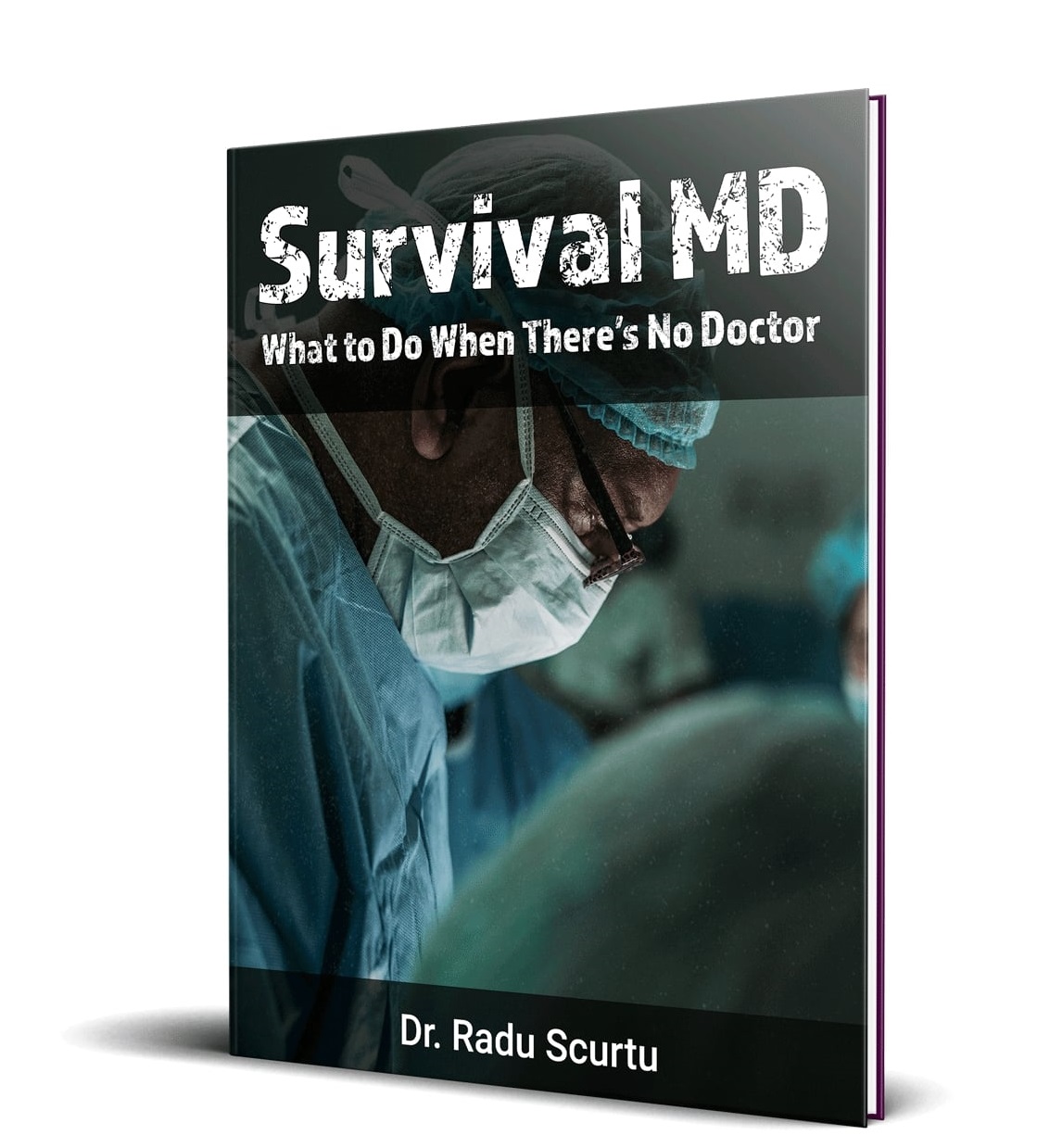
But that was fine. I knew NOTHING about how to be your own doctor in a crisis. So I asked all the dumb questions (so you won't have to). When I didn't understand something, I asked the doc to rephrase it in plain English. And when we put it all together, it turned out to be the most practical course on medical preparedness you'll ever find. We called it Survival MD-What to Do When There's No Doctor
"This book is a must-read for disaster preparedness. It is clearly written, easy to understand, and extremely informative. I highly recommend Survival MD!" - Zabian Crosby
"I think that everyone in the U.S. should have this manual. Could save your life!" - Mike Kirsch
Before I go on and explain what's inside, I want to set the record straight.
Here's what Survival MD is NOT:
First of all - This is NOT a medical tome. If you're planning on becoming a doctor or a registered nurse, this is NOT for you. This is a practical, down to Earth, plain-English course on how a layman can "replace the doctor"-when there is no doctor available and you're in a life and death situation.
Second of all - It's NOT a book on how to treat yourself when you can easily go to your doctor. That would be plain stupid-and it would be irresponsible for me to suggest otherwise. If you're looking for a way to stop going to the doctor when there's nothing wrong with the healthcare system... it's my duty to tell you that you might put your life in great danger.
Third (and frankly I don't care if this hurts our sales)-this is one book I hope you will never need. Just like I hope you never have to shoot your gun in self defense-but it's wise to protect yourself.
"Si vis pacem, para bellum"